Knock-Down vs Assembled Furniture for Export from Foshan
Compare packing volume, structure, hardware, installation skill, site access, inspection and after-sales records.
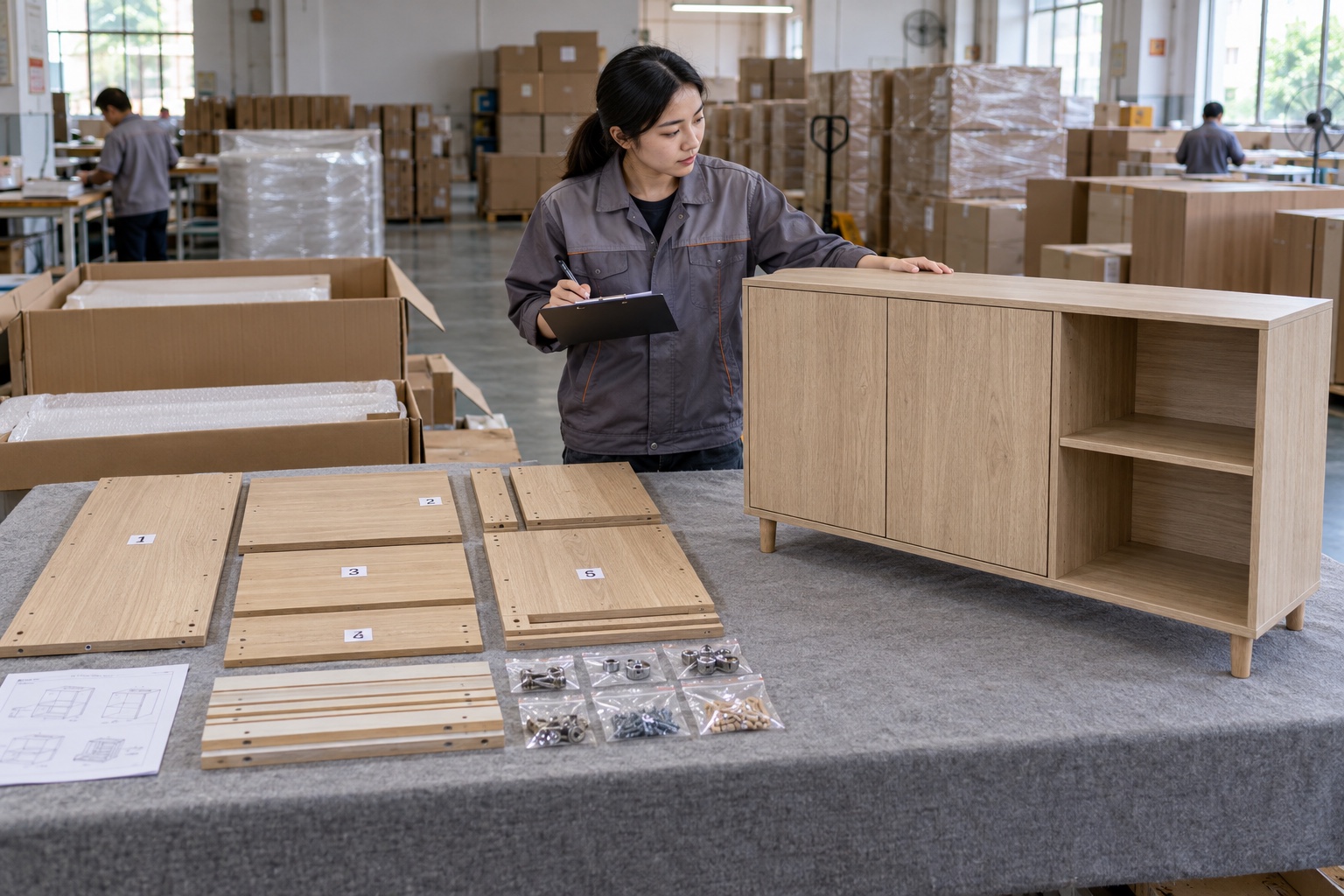
Knock-down and assembled furniture each suit different conditions. Flat or knock-down packing may improve handling and volume, but increases dependence on joints, hardware, instructions, tools and installation quality. Assembled furniture reduces site assembly but requires access, protection and transport-load checks.
Scope of this guide
This guide provides an execution framework for furniture sourcing and product selection. Contract, inspection, freight, installation and destination-country requirements should be confirmed in writing by the relevant supplier or professional adviser.
Set the decision standard first
- Compare packing and site access
- Assess structure and repeated assembly
- Control hardware and parts
- Define installation skill and tools
What to define and retain
| Specification field | What to define |
|---|---|
| Compare packing and site access | Check package dimensions, handling route, lifts, doors, stairs and final room entry |
| Assess structure and repeated assembly | Confirm joints, alignment, load transfer, loosening risk and whether repeated disassembly is permitted |
| Control hardware and parts | Create part IDs, hardware-kit lists, spares and mistake-proof orientation marks |
| Define installation skill and tools | State labour, tools, sequence, levelling, fixing and specialist trade requirements |
| Design separate inspection standards | For knock-down items check trial assembly and completeness; for assembled items check structure, protection and transport condition |
Recommended workflow
- Compare packing and site access: Check package dimensions, handling route, lifts, doors, stairs and final room entry
- Assess structure and repeated assembly: Confirm joints, alignment, load transfer, loosening risk and whether repeated disassembly is permitted
- Control hardware and parts: Create part IDs, hardware-kit lists, spares and mistake-proof orientation marks
- Define installation skill and tools: State labour, tools, sequence, levelling, fixing and specialist trade requirements
- Design separate inspection standards: For knock-down items check trial assembly and completeness; for assembled items check structure, protection and transport condition
At every step, retain the product ID, version, date, owner and written confirmation so critical decisions do not remain only in chats or verbal discussions.
Common execution problems
- If this is not defined in writing: Compare packing and site access — Check package dimensions, handling route, lifts, doors, stairs and final room entry
- If this is not defined in writing: Assess structure and repeated assembly — Confirm joints, alignment, load transfer, loosening risk and whether repeated disassembly is permitted
- If this is not defined in writing: Control hardware and parts — Create part IDs, hardware-kit lists, spares and mistake-proof orientation marks
Execution checklist
- Confirmed and retained: Assess structure and repeated assembly
- Confirmed and retained: Control hardware and parts
- Confirmed and retained: Define installation skill and tools
- Confirmed and retained: Design separate inspection standards
Related guides on this site
- How to Specify Furniture Hardware in Foshan
- How to Specify Stone Furniture Tops in Foshan
- Furniture Dimensions and Tolerances in Foshan: Drawings and Acceptance
Frequently asked questions
Does knock-down furniture always reduce freight cost?
No. Compare actual packed volume, quantity, protection, installation and potential rework costs.
Should knock-down furniture be trial assembled before shipment?
Trial assembly can verify parts, holes, hardware and instructions for new, custom or high-risk structures; agree the scope by project.
Choose the shipment form from the product structure and site conditions
For project-specific execution, prepare the destination country, room list, quantities, critical dimensions, material preferences, budget direction and target timing, then use the contact section on this site.